
McMullen County Criminal History Checks
Begin with the record closest to the event. The combined County/District Clerk searches felony files from the traveling district courts and misdemeanor files from County Court. The Sheriff is the first call for a recent arrest, an incident report, warrant verification, or the name of the jail that received a prisoner. A statewide name search through Texas DPS adds public conviction and deferred-adjudication data, but it does not replace either local office. Older paper matters may also be absent from re:SearchTX.
Bring a full name, spelling variants, an approximate year, and a case or incident number when one is known. Ask for felony and misdemeanor files separately. A date of birth can help distinguish people, but send it only through a channel approved by the office. Follow a possible name match back to the source file before treating it as the correct person.
- Ask the combined clerk for McMullen County felony and misdemeanor cases under each known name.
- Search re:SearchTX for electronic cases, filings, documents, and hearings.
- Call the Sheriff for a recent arrest and identify the arresting agency, receiving jail, and booking number.
- Use the Texas DPS public conviction search for the statewide public record layer.
- Request the court file, arrest report, or certified disposition from the office that created it.
McMullen Records Span Several Counties
McMullen County operates with shared and traveling parts of the justice system. The 36th, 156th, and 343rd Judicial District Courts each serve five counties and sit in Tilden when their calendars bring them here. The District Attorney also works in this multi-county setting. Most strikingly, the Texas Commission on Jail Standards lists zero local jail capacity. A person can be arrested in McMullen County, booked into a facility elsewhere, prosecuted at the courthouse in Tilden, and later appear in a state system.
That structure changes the search path. The Sheriff can say where a prisoner was sent, but the receiving jail holds its own intake, bond, release, mail, and visitation data. The local clerk holds the criminal case. Texas DPS receives qualifying fingerprint, prosecutor, court, and supervision reports. No commercial page can combine those official roles with certainty.
Official Background Checks in Texas
The Texas Department of Public Safety Crime Records Division maintains the Computerized Criminal History system. Its public name product discloses qualifying conviction and deferred-adjudication information under state law. An account holder prepays search credits. Each search costs one $1 credit, including a no-match search, and card purchases add a 2.25 percent charge per credit plus a $0.25 transaction fee. Soundex can return similar-sounding names, so the result remains a possible match rather than proof of identity.
For review of your own Texas record, use the DPS fingerprint route through FAST and IdentoGO by IDEMIA. No fixed IdentoGO site was verified inside McMullen County. Use the live vendor locator and the service code for the authorized purpose. The FBI also lets a person order their own Identity History Summary through its electronic ordering portal. Neither product replaces the detailed McMullen County court file.
| Channel | Best use | Published cost |
|---|---|---|
| DPS public name search | Public Texas conviction and deferred information | $1 credit plus card charges |
| DPS fingerprint review | Positive self-review of a Texas CCH record | Confirm purpose and vendor fee |
| McMullen clerk | Local prosecution file and disposition | Local fee not published |
| Sheriff request | Local incident or arrest report | Local fee not published |
McMullen DPS Name Search Fields
DPS asks for descriptive and numeric details that can narrow a search. Last, first, and middle name fields support name matching. Date of birth is strongly useful. Sex and race may narrow a result, while Multi-Entry can queue more than one search. The result describes exact, partial, and Soundex matching. Preview data may be shown before a full record is opened, but opening the record consumes a credit.
The official DPS instructions explain that some records need offline technician work and later arrive through the account Message Center. Search support is available at 1-855-481-7071. Data that appears wrong can be raised with the inaccurate-data line at (512) 424-7256. A certified McMullen County disposition often supplies the proof needed to reconcile an outcome.
| Field | Use | Search note |
|---|---|---|
| Last and first name | Core name search | Exact and Soundex matches may appear |
| Middle name | Distinguishes similar names | Optional or unspecified |
| Date of birth | Strong numeric match | Use an accurate date |
| Sex and race | Descriptive narrowing | Does not prove identity |
| Multi-Entry | Queues several searches | Use View or Submit afterward |
Kinds of Criminal Records
Each McMullen County record follows a different event and custodian. A deputy or trooper writes the incident and arrest report. An outside receiving jail creates booking data. Prosecutors and courts create charging instruments, motions, settings, judgments, and sentences. DPS builds its statewide criminal-history file from fingerprint-linked arrest cycles and later agency reports. The proper source depends on whether the question concerns custody, accusation, prosecution, conviction, or supervision.
- Arrest and booking: the arresting agency and outside receiving jail document intake and custody.
- Court case: the combined clerk keeps complaints, indictments, dockets, pleas, orders, and dispositions.
- State criminal history: DPS compiles reportable arrest cycles and submitted outcomes.
- Warrant: the issuing court and Sheriff verify status because no public county list exists.
- Custody and supervision: TDCJ, the sentencing court, CSCD, and parole offices hold different layers.
McMullen Arrests Without Jail Beds
The lack of a local jail does not mean McMullen County has no arrests. It means a lookup must cross a county line after the Sheriff identifies the receiving facility. The 2022 jail-standards report recorded an average of 14 local inmates housed elsewhere. No official McMullen jail roster, lobby kiosk, visitation vendor, or recent-bookings page exists. Start with the Sheriff at (361) 274-3311, then use only the receiving jail's official service.
The TDCJ inmate information hub applies only after a sentence places someone in state custody. Its locator is not a substitute for an outside county jail roster or a recent pretrial booking. The same divide applies to the federal Bureau of Prisons. Search the custody system that matches the sentence and current location.
The official DPS conviction-search instructions show the statewide route to use later, after a case has reached a reportable outcome.
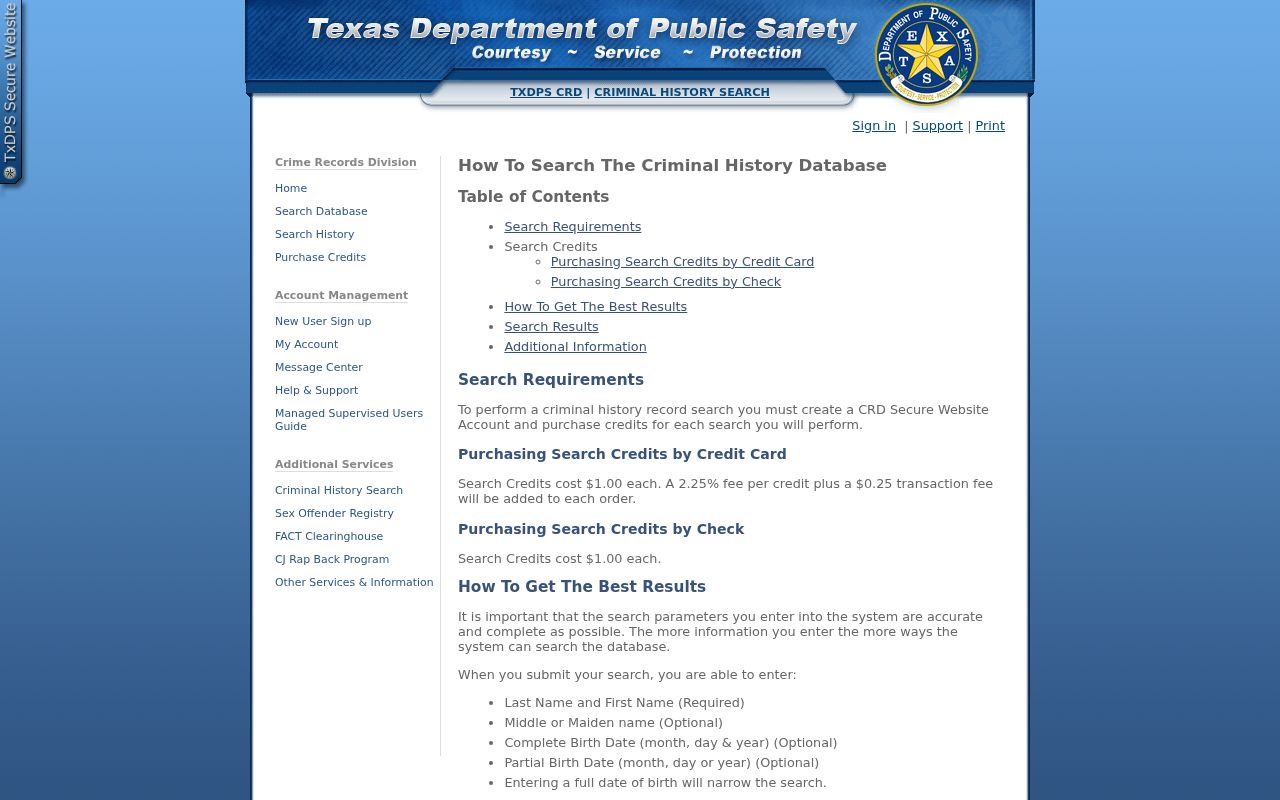
This source image reinforces why a state conviction record answers a different question from a recent McMullen County booking.
McMullen County Criminal Records: What They Contain
A DPS criminal-history entry centers on identity and an arrest cycle. A McMullen County court file centers on the cause number and prosecution. Booking data centers on custody. Charges can change between intake and filing, and a later disposition may not reach the statewide repository at once. Read the title of the record and the name of the custodian before comparing fields.
| Name and identifiers | Name, aliases, date of birth, SID, FBI number, and fingerprint-linked identifiers where authorized |
|---|---|
| Arrest and booking | Date, agency, tracking number, intake charges, bond, receiving jail, transfer, and release |
| Case data | Cause number, court, filing date, charge, pleadings, settings, and accessible documents |
| Disposition | Conviction, dismissal, acquittal, deferred adjudication, or other recorded outcome |
| Sentence | Term, fine, community supervision, custody, and related orders |
| Later status | Supervision, prison location, parole review, release, or reported correction |
McMullen Reports Have Three Custodians
An incident report explains an agency response and investigation. An arrest record documents seizure and custody. A court file documents prosecution. Asking one office for all three can produce an incomplete answer because no single McMullen County custodian creates every layer. Sheriff records are requested at 401 Main Street or P.O. Box 242 in Tilden, by phone at (361) 274-3311, fax at (361) 274-3736, or email at Sheriff@mcmullencounty.org.
Highway cases investigated by a state trooper belong with Texas DPS rather than the Sheriff. Court pleadings and dispositions belong with the combined clerk. A focused Texas Public Information Act request should name an existing record, date range, event location, incident number, requested format, and cost ceiling. The law calls for prompt production, which means as soon as practicable under the circumstances. It does not promise every request a fixed ten-day delivery.
McMullen County Sheriff
401 Main Street, Tilden, TX 78072
(361) 274-3311
After hours: (361) 449-2271
County/District Clerk
501 River Street, Tilden, TX 78072
(361) 274-3215
Monday through Friday, 8:00 a.m. to 4:00 p.m.
Texas Public Access Laws
Texas separates agency records, judicial files, confidential criminal-history data, registry data, and records subject to relief. The Sheriff applies the Texas Public Information Act to law-enforcement requests and may redact protected content or seek an Attorney General ruling. Courts control judicial records through court authority and rules. DPS may disclose only the public slice authorized for its name-search system.
Key Texas authorities:
Government Code Chapter 552 creates public access and prompt-production duties while allowing law-enforcement exceptions.
Government Code Section 411.135 authorizes the DPS public conviction and deferred-adjudication service.
Texas judicial access rules govern court records apart from ordinary agency requests.
Code of Criminal Procedure Chapter 55A governs current expunction eligibility and procedure.
Code of Criminal Procedure Chapter 62 sets public registry fields and statutory exclusions.
McMullen Warrants Lack a Portal
No official public McMullen County warrant database was found. Call the Sheriff at (361) 274-3311 for execution and status questions, then contact the court that may have issued the order. The combined clerk answers county and district cause questions at (361) 274-3215. Justice of the Peace clerks answer at (361) 274-3372, but that phone line closes at 1:00 p.m. even though the office stays open until 4:00 p.m.
Arrest warrants, bench warrants, capias entries, and search warrants are not interchangeable. Some search warrants stay sealed during an investigation. A person who discovers a possible warrant should obtain the cause number and issuing court, ask for safe instructions on surrender, reset, bond, or payment, and seek legal advice where needed. Do not visit merely to test whether an arrest will occur. Written confirmation of a recall is useful because system updates can lag.
McMullen Supervision Splits Two Ways
Texas calls probation community supervision. The sentencing court's judgment is the public starting point, while a Community Supervision and Corrections Department keeps the detailed supervision file. McMullen County does not publish a standalone CSCD page. Ask the combined clerk or a district-court administrator which office and officer serve the case. A judgment, motion to revoke, or motion to adjudicate can appear in the court docket even when no public probation roster exists.
Parole belongs to a different system. The Texas Board of Pardons and Paroles makes release and revocation decisions, and the TDCJ Parole Division supervises people after release. The official county-to-parole directory assigns McMullen County to the Corpus Christi District Parole Office in Region IV. TDCJ search details may show parole review information, while IVSS supplies free custody and parole notifications. A clerk judgment should be checked for community supervision; TDCJ and Board channels should be checked for parole.
Restricted, Sealed & Expunged Records
Texas reorganized expunction law into Code of Criminal Procedure Chapter 55A in 2025. Qualifying paths can include acquittal, pardon or actual innocence, identity misuse, certain dismissals or no-bills after statutory conditions, and specified program completions. Eligibility is technical and can turn on every charge from the same arrest. A dismissal by itself does not erase all Sheriff, jail, clerk, and DPS records.
An order of nondisclosure has a different effect. It generally limits public release of qualifying criminal history while preserving access for authorized entities. McMullen County directs questions about a petition for nondisclosure to the combined clerk. Expunction can require listing every agency that holds a record, filing in the proper court, obtaining certified orders, and later checking that each custodian complied. Juvenile records and victim or personal identifiers have their own restrictions.
The McMullen County clerk contact page identifies the local filing counter used for the cause file, certified copies, and relief filings.
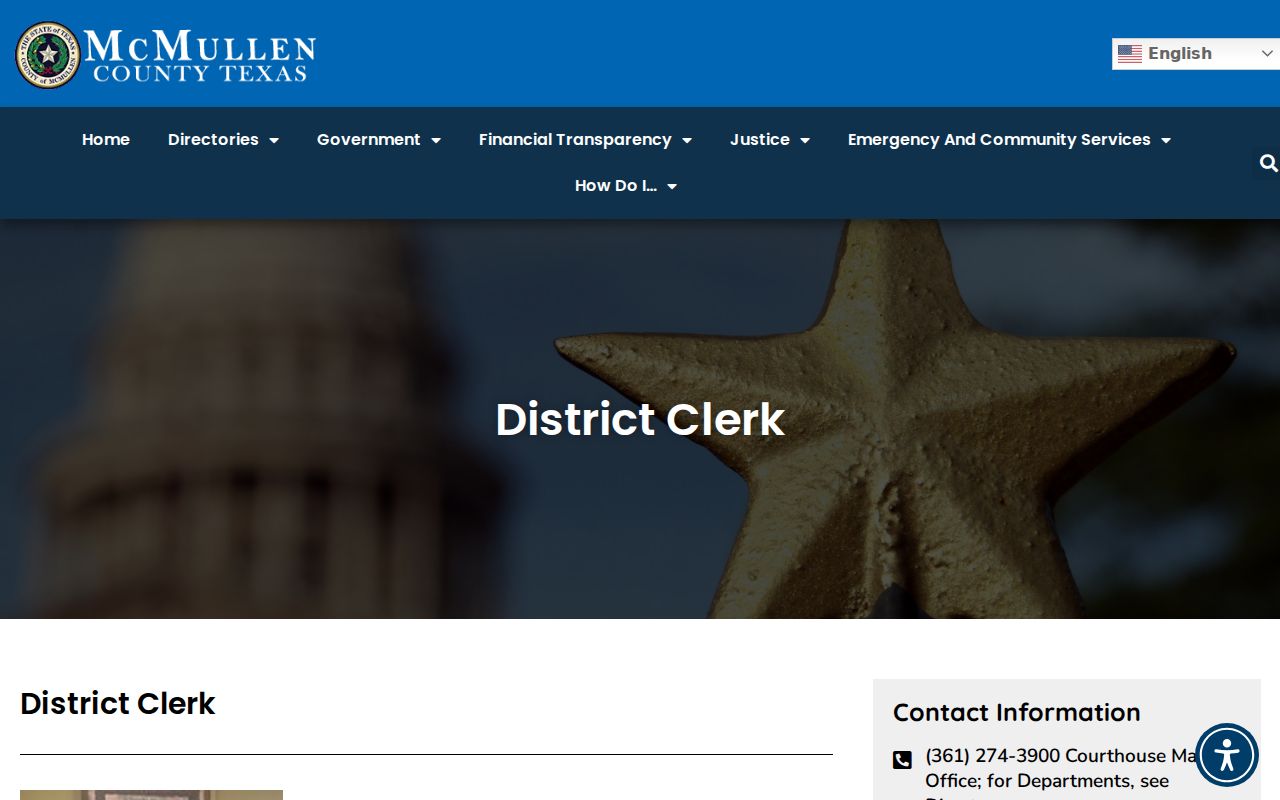
The contact details matter because a local order begins with the correct McMullen County court file, not a commercial removal request.
McMullen Felonies Travel to Tilden
Three district courts hear McMullen County felonies: the 36th, 156th, and 343rd. Each also serves Aransas, Bee, Live Oak, and San Patricio counties. The combined clerk remains the local file custodian when those judges sit at the courthouse. County Court hears Class A and B misdemeanors, while the Justice Court handles fine-only matters within its jurisdiction.
| Texas class | Ordinary range | McMullen court |
|---|---|---|
| First-degree felony | 5 to 99 years or life; fine up to $10,000 | District Court |
| Second-degree felony | 2 to 20 years; fine up to $10,000 | District Court |
| Third-degree felony | 2 to 10 years; fine up to $10,000 | District Court |
| State jail felony | 180 days to 2 years; fine up to $10,000 | District Court |
| Class A misdemeanor | Up to 1 year; fine up to $4,000 | County Court |
| Class B misdemeanor | Up to 180 days; fine up to $2,000 | County Court |
| Class C misdemeanor | Fine up to $500; no ordinary jail term | Justice Court when within jurisdiction |
Published 2026 County Court settings are episodic rather than daily. Five misdemeanor dockets are listed, each beginning at 1:00 p.m. A self-represented person who needs a reset uses the county process and sends the request to the published court email. The court page directs case discussions to the County Attorney. JP communications go to the clerks, not directly to the judge.
The official district-court roster documents the three traveling courts and their administrators.
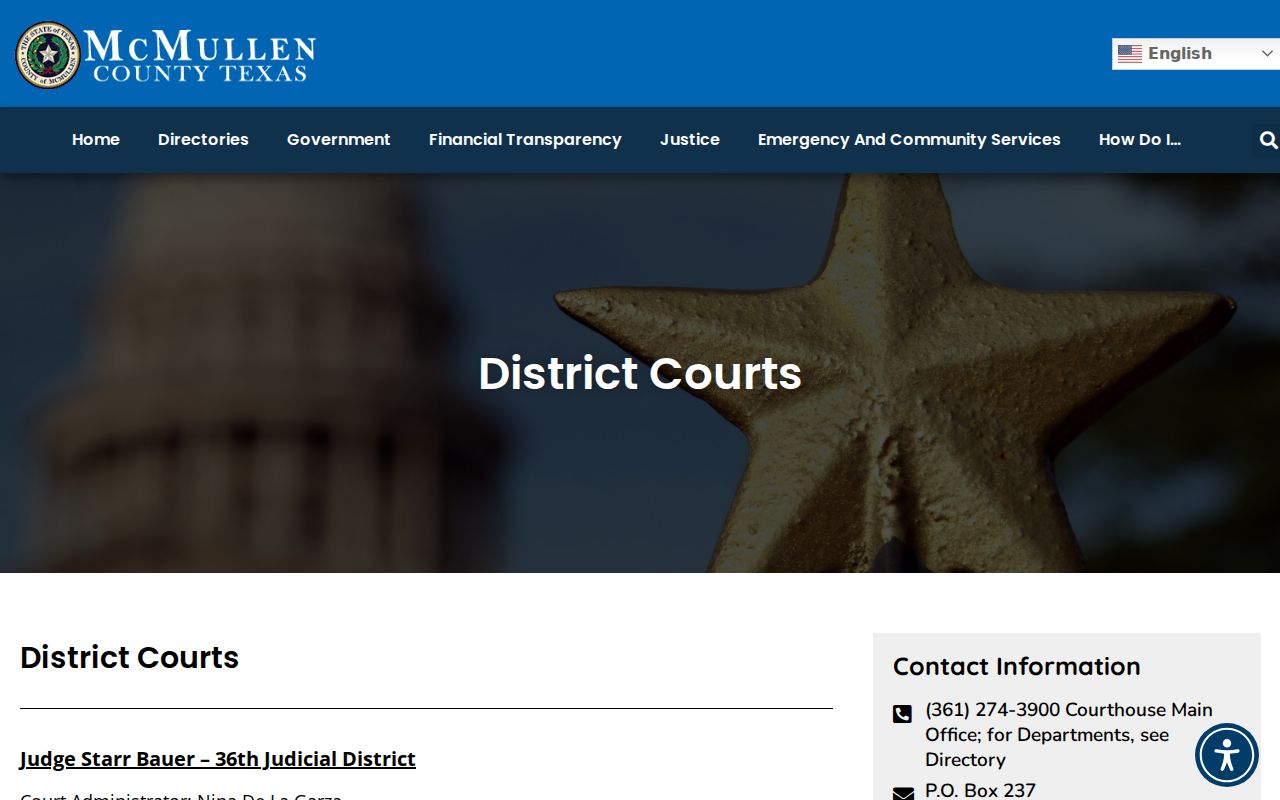
That shared court structure explains why the local clerk is often more useful than guessing which regional office has a McMullen County file.
City-by-City Criminal Records in McMullen County
McMullen County has no incorporated cities. Tilden and Calliham are unincorporated census-designated communities, so neither has a municipal police department, municipal court, city jail, or qualifying city record page. Countywide law enforcement starts with the Sheriff. Fine-only cases go through the Justice Court when within its authority, misdemeanors through County Court, and felonies through the traveling district courts. This avoids inventing city systems that do not exist.
McMullen's 1930 Records Hub
The courthouse at 501 River Street is both an active records office and a record of local government itself. The Texas Historical Commission dates the two-story brick building to 1930. William C. Stephenson designed it in a Classical Revival style with Mission influence. A rear addition followed in 1964, and an elevator was added in 1987. That elevator is the only accessibility feature documented in the official research, so callers should confirm any other needed accommodation before a visit.
The county was created in 1858, organized in 1862, abandoned amid Civil War-era bandit activity, and reorganized in 1877. Tilden, first known as Rio Frio and later Dog Town and Colfax, became the county seat. Today the combined clerk and traveling courts still bring felony, misdemeanor, certified-copy, expunction, and docket questions to the same River Street building.
The official McMullen County homepage presents the courthouse address, office hours, and current service notices.
The county homepage image ties the historical courthouse to the modern record counters that still serve McMullen County residents.